



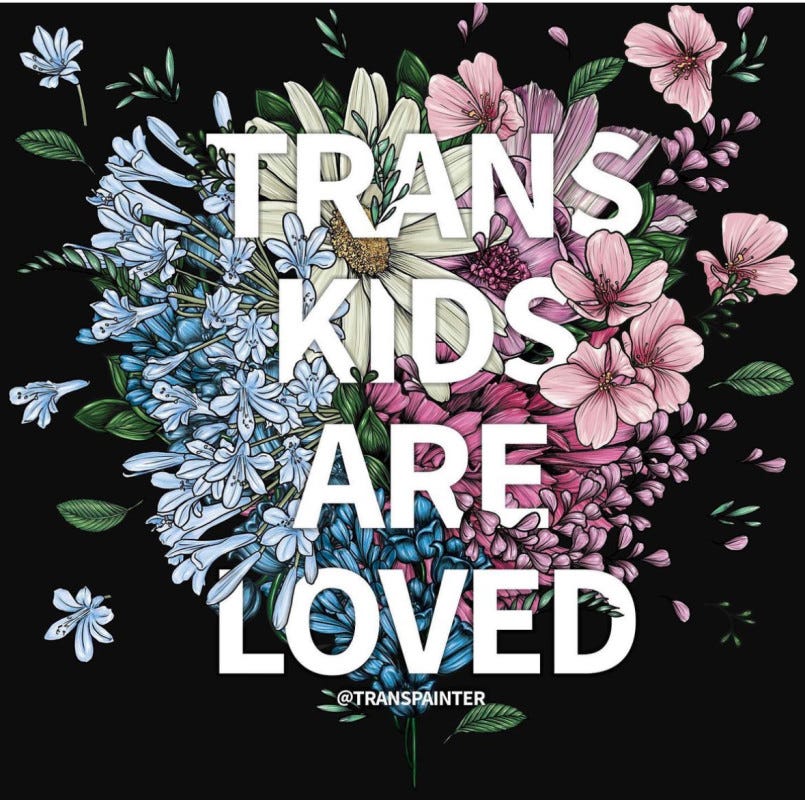
Childhood should be a time of play, discovery, and coming to know oneself with support and unconditional love from those closest to you. On the other side, parenting can be described as preparing the person or people you love the most to leave you one day and go out into the world successfully. There is a common word in both descriptions - love. And this Pride month, we celebrate fierce love. We are humbled to have three parents of trans, nonbinary, and gender-diverse children share their family’s experiences - the humdrum daily, the dazzling, the demanding, and everything in between. All families experience upheaval and challenges, but not all families experience challenges that put them in danger. That said, we also remind everyone that Pride began as a riot, a rebellion for equality and respect, and that rebellion continues. So when we say love fiercely, we mean to continue fighting until all childhoods are full of play and have the human rights we all deserve, and that those childhoods grow into thriving adulthoods.
Thank you to all three parents for their participation ♥ And a special thank you to @transpainter for permission to use the artwork above.
What makes your family special?
Parent 1: What makes us special is that there’s actually nothing very special or out of the ordinary about us! We like watching The Mandalorian on Disney+, just adopted an adorable shelter dog, struggle to get our kid to turn off the screens, love and support each other even when we drive each other up the wall, and one of us just happens to have been born in a body that doesn’t match their brain. If there’s anything that puts us in a smaller subset of the world is that we were open to the reality of our kid being able to tell us who she really is, no matter her age, and that as adults, our job is to love her and believe her.
Ciele Andoy: I think what stands out about my family is that we are absolute Die Hards for each other. We are unconventional and wildly passionate; I like to say that we are both lovers and fighters.
My oldest daughter and I were a single-parent unit for the first 11 years of her life until I met my now husband. I am very honest about the struggles that she and I had throughout her life—poverty, fighting the system, and many emotional transitions—but it was a time together that I absolutely cherish and I’m so proud of. When my husband came into our lives he naturally provided a force field of protection around us, that I am often at odds against but that I’m now realizing was something that I (we) very much needed.
Long story short: we met and fell madly in love, they met and fell into a relationship natural and true, he and I married and he adopted her. Happily ever after.
After seven years of fertility struggles, we welcomed our second child, exactly eighteen years younger than our first. This child came to us as the literal embodiment of joy, smiling, laughing, singing, dancing, and creating from as early as could be all the way until the very minute that I’m responding to you. I have earbuds in, but I can still hear her singing downstairs! This child was assigned male at birth, and at five years old, after a good couple of years of sending us signs that she didn’t necessarily fit into the gender mold that we and society had provided her, she came to us and told us, “I am a girl.”
I do think our family is special, as all families are, but I think ours is especially unique in that when someone says, “How many kids do you have?” it’s not just a simple answer; and when someone says, “Aren’t girls so great!” I think, you have no idea how big of a conversation I could get into with you right now. Everything we have is this incredible story of resilience and love and literal fighting for what we have together. There’s lots of infighting too, so I don’t want to paint this picture of certainty and preciousness. As I said, we are a wildly passionate bunch. We are people of passion, we are absolutely not perfect, and we are constantly learning from each other.
Parent 3: Our family is no more special than any other family out there. We are doing our best, day by day, to build and support each other’s independence and the ability of each of us — parents and children — to live authentic lives, with joy and purpose.
Several years ago, our then 10-year-old child shared with us that they identified as non-binary. We embraced their decision, and learned from them about the process that led them to that decision. We agreed together that they would enter therapy so that they had a safe place to discuss their gender identity and other emotional needs.
At the start of high school, our now-teenager came out as transgender. We weren’t surprised by this decision, it was part of the conversation and process we were all participating in since his bravery in talking to us from such a young age.
Supporting a transgender child should not be viewed as a radical act. Our family has learned, and unlearned, so much of what society “taught” us about gender and binary roles through the experiences of our children. It’s a tremendous gift, and we learn more each day about how beautiful it is to be in a world where we can be our full selves.
Our child is a gentle navigator for our family. He embraces our questions, and reminds us of things we know but may have forgotten. We’re an intergenerational household, with grandparents and children in the same place, learning from each other.
What do you wish people knew about your child?
Parent 1: That her transness is the least interesting thing about her. And that she’s very perceptive, and can tell the difference between environments where teachers or people make clear that they view the world, identities, and relationships as diverse - that there’s not just one way to look, or to be from environments where she is to be expected to “explain” or “justify” her identity to others or to educate entire schools, kids or adults who don’t yet have a good understanding of transgender and gender nonconforming kids. Thankfully, there are a host of places where that information exists for those who genuinely want to learn and understand, including PFLAG and GLSEN.
Ciele Andoy: I wish people didn’t feel like they have to know anything about my child. She’s a normal child—loud, boisterous, loving, emotive, creative, active, annoying!—but because she is “different” than the norm that has been laid out for us as society, then folks feel like she is a topic of conversation. As a transgender child, especially one who revealed her true self to us at such a young age, she has already experienced being labeled as “Other.” I rage against that notion, but I also want to celebrate her being and her truth. These are struggles that I have personally, but she is perfectly happy just as she is. Her being transgender came from such an innocent place; she obviously didn’t even know the term “transgender,” until we read a book about it to her and she recognized that she somehow fit into that story. She’s just a kid in the world. But she’s a kid in the world who somehow found herself in a place that some people label as brave and some people label as vile, so ultimately she’s a kid who moves through this world as a label. She’s pretty oblivious to it now, but I know soon enough she’ll realize that she’ll have to decide if by simply existing, she wants to be an activist or just a human that doesn’t have to explain herself to anyone.
Parent 3: I wish people would accept that they simply do not know my child, just as I do not know theirs. I wish they could see how my child so fully loves and understands how hard it is for people to unlearn gender and sex the way it has been enforced through religion and society for so many years. My child answers hard questions all the time, and loves people for asking them. He practices a life where he treats others as he would like to be treated: respectful curiosity, engagement, learning, and respect for lived experiences.
Is there anything you have discovered about yourself thanks to your child?
Parent 1:That I want to become involved more in activism, and I wish I could go back and change the decades in my life when I was less involved in showing up and speaking out against racial injustice, reproductive injustice, unchecked gun violence, and LGBTQ+ injustice. But I have also discovered that the best time to get involved is always right now and that what matters is continuing to show up, to keep learning, and to not expect to know everything all at once. I’ve discovered that the instinct to not speak up as much as we could have when things didn’t personally affect us - as the Martin Niemöller poem describes - is common, but that even when we don’t understand the direct links right away, we can trust that we’re stronger in a community than in isolation.
Ciele Andoy: Since my child was born, I have learned more about the emotional experiences of humans than I ever allowed myself to learn before. I’ve discovered that I am quite selfish and that I have little patience for emotional expression that doesn’t mirror my own; be it for my youngest daughter who has such explosive emotions that need to be known, for my oldest daughter who can be quite zen to the point that it feels dismissive, and to my husband who can’t seem to wrap his head around when I need him to be there for me. I’m working on it, I promise.
Since my child came out as transgender, I have learned how little I know, and how sure of myself I once was. I am a person who came into my own in the 90’s, and I’ve always held pride in my activism, my general hunger for knowledge, and my desire to “not be ignorant.” I have always fought for truth and for what I believe is the right side of history. When my daughter came to us as transgender, however, I quickly realized how little I knew about the trans community, how I didn’t personally have any trans friends that I knew of, and how rarely I had truly shown up for transgender rights as a whole. Basically, I was ignorant as fuck. I felt a lot of shame. I had to reckon with the fact that it’s one thing to say “I’m an ally,” and it’s a whole other thing to be an ally. I had to reckon with the reality that my own activism merely reflected my own struggles, as poor, a woman of color, a child of an immigrant, a single parent, etc… and it wasn’t until I was suddenly thrust into the world of being a Trans Parent, did I truly give a wholehearted shit about what was happening in the transgender community. So yeah, I don’t think that’s being an ally. I’ve learned from my child coming out as trans that I would like to be an ally and an advocate for marginalized communities not just in words but in actions.
I guess what I’ve learned from my child is that there is so much more to learn and that it’s okay to have lots and lots of feelings!
Parent 3: Many times my partner and I have said to each other, imagine what a different lens we would have if we’d been raised in a gender-inclusive family and society. I would have viewed my own sexuality, gender, gender expression, and relationship with cultural expectations so differently. I’m not saying the trite “oh, we all would have experimented” type thing—I truly believe that freedom in this space would have given me so much more freedom in my life, in understanding who I am is not something dictated to me, that the world’s fluidity is a beautiful thing because it means we’re actually listening to each other, our bodies, and our authentic expressions of selves.
I have discovered through my child that it’s incredibly easy to raise a transgender child when you live, as I do, in a community where there is access to healthcare and one has the health insurance and means to take advantage of these programs. I cannot imagine embarking on this journey—and protecting my child, supporting his growth, giving him the basic things he needs—in just a couple of states over, where his care would be banned, his life would be restricted, and we would be so profoundly discriminated against for trying to take care of a healthy child.
How have you found support in your community?
Parent 1: We’ve been lucky that in each community we’ve lived in over the past 5 years, both Red and Blue states, we’ve found hubs of people and caregivers who are doing the work to educate their families, friends, schools, - either as allies or as someone with personal experience with loving someone in their life who is trans. PFLAG often runs groups for parents specifically of trans kids, which has been great - and other LGBTQ+ organizations with community programming often have meetings as well. NYC has the Gender and Family Project at the Ackerman Institute, which is a remarkable organization for parents of trans and nonbinary kids. Also, PFLAGNYC has Stepping Stones.
Ciele Andoy: So far it’s been incredibly difficult to find support in the transgender community, mainly due to the pandemic. I personally can’t wait to have actual in-person support groups! I have met, in total, three other parents of trans kiddos who are similar in age to ours. One of them has kind of ghosted me at this point (but that’s okay because I know we all have our own struggles), one of them we are actively working on our friendship as a family, and one of them lives a good fair distance away so we don’t get to see each other as often as we’d like. Needless to say, it’s been difficult. I would like to give a shout out to TransFamilies.org, who does everything in their power to facilitate connection, community, and support to families of transgender kiddos, and also to the Camp Wild Heart podcast and community, for their thoughtful sharing of stories so that us parents feel less alone.
The interesting and amazing aspect of meeting other parents of transgender kiddos is that feeling of recognition, and ultimately relief. When someone makes that age-old joke, “Parenting just doesn’t come with a manual!” I want to say, “Yeah it does! The billions of other parents who have also done it!” Whereas, being the parent of a trans kid truly does not come with a manual. That’s me sounding bitter, I know, but it feels so true! So far I have found and read four books written by parents with transgender children, and I hungrily bleed them dry of information and any tidbit of something that I can relate to or recognize, to validate my own experience. It’s a desert out there, but I’m hopeful that the oasis of stories is growing day by day.
In my own community, I’ll be honest it’s been very difficult finding the support I need. I feel so fortunate that my husband and I are on the same page, and that together we’ve been active in creating a life of nothing but support, acceptance, and love; however, finding out the true motives of folks, even our friends, has been quite tricky. We live in a famously liberal area of the U.S., and when we came to our friends with the news of our child being a girl, often the responses were more “congratulations” or “yay you” and less “how are doing?” I think that our friends around here acted like it was no big deal, but my husband and I were so in the thick of anxiety, feeling ultra super protective, and honestly so insulated and alone. So that felt… weird.
On one side of the acceptance spectrum, we had some family members who think that what our family is going through is very wrong, evil, sinful, and all the things, and with those folks there was no question about saying goodbye to them, although very difficult. On the other side of the spectrum, we know people who as extreme feminists don’t believe in supporting the rights of transgender women and girls, and it would be easy to tell those folks to kindly go fuck themselves, but it’s not as easy to know who is supportive and truly who is not. I also had a friend who basically said that her kids “don’t see gender,” which felt not only dismissive of what my child was going through— someone who absolutely sees gender and who will spend her entire life trying to properly fit herself into this world—but it also reeked of haughtiness and ignorance, and was just so opposite of showing support for transgender folks.
Then in the middle of the spectrum we’ve had so many friends who have been kind and perhaps gentle with their responses to our trans kiddo, but then we often find out that they are talking amongst themselves, their friends, and their families about our child. I understand that they are coming from a place of trying to understand, but my main defense is, “She doesn’t want to be talked about! None of us do!” So I find myself being more and more protective of who I feel comfortable telling or even talking about it, which has led to a sort of isolated existence. I’m not saying that this is right or wrong, but that it just is. These are the struggles that we’ve had with finding support and with building our community within our own and at large.
Parent 3: We’ve found support through friends and family, and we’ve offered the same to families at different points in this journey.
What would you say to other parents beginning a journey similar to yours?
Parent 1: Reach out and find your people. Don’t try to do this alone.
Ciele Andoy: Go to therapy, if you can. In my mid-forties, I had finally started therapy about one year before my daughter came out to us. It turns out that after twenty+ years of being a high-functioning victim of complex and acute trauma, I have lots of related anxiety, depression, and a bit of ADHD that was preventing me from moving forward in a healthful way. Who knew! I feel so fortunate that I was already on a path towards healing, which enabled me to be more freely open towards my child and my family as wholly as I could be, and knowing when and where I was faltering and how to move through those feelings. But I don’t feel like I could have done that alone, so I really truly cannot stress enough how important it so be talking all of this through with a professional.
Take as much time as you need. This is a long and non-linear journey of infinite and often unanswerable questions. It’s in our nature to try and figure it all out, and that can be so incredibly taxing. You owe it to yourself and to your child to take whatever time you need to move through this new life that you’re building together; which is to say, you literally do not owe anything else to anyone else. Not your time, not your knowledge, not your experience, not an explanation, not anything at all. “Self-preservation” has been what resonates most for me.
Parent 3: I strongly recommend that parents not keep this conversation internal to one’s family. A child is likely or wanting to live outwardly, to express their life and choices fully and openly. If it is safe, I think it is important for families to normalize conversations about gender transition and care. Keeping it so “private” only further stigmatizes it. I say that with the full awareness that this is a privilege afforded to people living in communities that have protections for transgender communities. I hope that we are all in the fight together for families where transgender people have been targeted by unconscionable political acts.
What can people do to support families like yours?
Parent 1: When you see people in positions of authority or power spreading transphobic misinformation and calling it “facts’ or “inquiry” - including some very high-profile media outlets - and you read those pieces that claim to be “just asking questions” about trans healthcare, ask yourself, who wrote this? Who is it quoting? Whose voice is it leaving out? What is their agenda? Does this have humanity’s best interests in mind, or is this part of the current wave of hate, ignorance, and fear that has been using any available bogeyman to justify controlling other people’s bodily autonomy?
Ciele Andoy: Similarly to what I’ve gone through in my own journey, I think what people need to first come to terms with is their own ignorance when it comes to issues in our transgender and queer communities. Read more (and I’m not just talking about on social media), watch more, listen more, and actively seek out ways to learn about these communities. For instance, not only did I have no idea about the medical details of hormone treatments for young and adolescent trans folks, but I didn’t really know exactly how the adolescent body works besides general menstruation and reproduction! And I’m still learning!
I will give one important example of this, that I’ve had to wrap my head around and also explain to several friends. One of the many pretty unsupportive responses that I’ve gotten when talking about our potential gender journey with puberty and also our daughter’s innate and long-held desire to have kids, are, “Well, puberty sucks for everyone!” and “If she wants to have kids later, she can!” What we’re not actually taught, however, is that females are born with their eggs and they are a finite supply (most of us know that), but males have an infinite supply of sperm but it is not produced until they go through puberty. So for a child assigned male at birth who transitions to female, they have to make a gravely important decision at a very crucial age about going on puberty blockers, to prevent their bodies from going through the puberty of their assigned (opposite) gender; which on one hand will potentially prevent fateful gender dysphoria within their own bodies as well as outwardly in society, but on the other hand would prevent them from being able to produce sperm if reproduction is a priority of theirs. Mind you, they’ll have to weigh all these options at like TEN years old, with a professional and hopefully with a supportive family.
You may or may not want to include that tidbit in your piece, because it’s coming from the miseducation of little old me. But my bigger point is that way too often folks make comments that they think are supportive, but in relation to the very huge and daunting decisions about literally everything that transgender kids and their families are going through—from traveling to entering your kiddo in gymnastics, to who do we tell/who do we trust, to how best can I support my child and her friends while basically sending eye message pleads of please don’t harm yourself, my sweet—also having to educate our friends on what they could actively be learning on their own, is just so utterly exhausting.
If someone would like to support transgender families, be a good listener to them, be an active ally, and on your own time, educate yourself and those around you. Conversely, I would also go so far as to say, ask those folks directly how to be supportive! I had a friend who very much thought they were being supportive by explaining to their child about “what it means” to be transgender by using my kindergarten child as an example but then saying, “But who knows! She may not be a girl anyway, and change her mind later!” When she told me that, my heart dropped to my ankles while my shoulders and the corners of my mouth, and my cheeks and eyebrows rose to an unnatural high, as I smiled and simultaneously suffered. That was not what I want folks to teach their children, and that is certainly not how my child wants to be talked about. I just really wish that my friend had thought to ask me first, on how it was best to approach the subject with her child, if at all. What it comes down to is these are conversations about my child’s private body parts and private thoughts, which is absolutely nobody’s business to be talking about, like, EVER.
On a friendlier, less fraught, and more applicable level… showing support to your transgender friends and family by showing your allyship to the world is invaluable. Wear the shirts, fly the flags, put the stickers on your car, announce your pronouns.
Fun fact, I was so anxious about school starting for my child, but felt a wave of relief when I saw the school principal sign her email with her pronouns, showing solidarity and subtly flagging her school as a safe space for our child. Not so fun fact, when I wear my trans Pride clothing I often fear that I’m outing my child against her will or actively putting her in danger. As friends and allies, however, you can wear all the things because you are not in as much direct danger as my child and our family. You can carry that torch for us, knowing that you are helping us lighten the load. (all the metaphors!).
The people who have shown us the most active solidarity and support are our lesbian friends, my mom who is a lifelong evangelical christian, all of my suburban neighbors who are 70+, and my very catholic neighbors, who are the only people who came to our door and said these words: “We don’t know any transgender people, but we want to tell you that we are allies to your family.” We live in an outwardly liberal area of the U.S. and way too often we have friends who say, “Good thing we live in a liberal bubble!” without asking what they can do to support us or what type of discrimination my family and our trans family friends have faced; including but not limited to sexual harassment cases against kindergarteners, tokenizing our children for the benefit of looking woke (both institutional and personal), being told that our children are the victims of sexual abuse, and our family being a point of conversation but not being asked to join in on the conversation.
Parent 3: We all need to take a stand to stop what is happening in the US, and the world, in attacking trans and non-binary people. The world’s movement that stood up for the right of same-sex marriage, for example, should be focused on making sure we overturn and prevent such discrimination. Time and time again, new generations will teach us painful things about our bigotry. Let’s not repeat history, let’s fight back together.
Is there anything else you would like to share with The Fold’s audience?
Parent 1: One of the most pernicious forms of bias my family has encountered has come not from conservative corners of the world, it’s come from the self-described “well intentioned” liberal ones. In particular, there is a false narrative being used to divide people who call themselves feminists from those who are trans-affirming feminists. This lie shows up in lots of ways, like passing trans sports bans by claiming to be “protecting women” or “being fair” – even as Title IX sports funding has been stripped away and women are regularly underpaid in professional sports (not to mention in professional life in general).
It shows up when politicians claim that locker room and bathroom bans shield women and children from threats, even though the highest levels of the Supreme Court and White House are filled with people who are accused or found liable of sexual assault.
It shows up when elected officials claim they’re looking out for children when they ban access to abortions and trans-affirming healthcare across the country – while refusing to ban guns that people are actually using to kill kids and people at horrific rates.
And lastly, it hides in the fallacy that trans women are somehow “taking away the gains that women have made by posing as women.” But this is a trap. The people who benefit from this kind of thinking are the people who want to keep power, by driving a wedge between people who might actually call them to account for their use of that power - and calling that wedge “protection.” We don’t need or want that kind of paternalistic protection. We need to have open and sometimes difficult conversations with each other, as peers, to get to the point where we recognize that the people spreading this misinformation are organized, and calculated, and working their plan very deliberately– and we need to be just as mindful, organized and deliberate, if not more so.
Ciele Andoy: Educate yourselves.
Be an ally in every way possible. Remember that your life is not in danger, but you could be advocating and carrying a part of the burden for someone who is.
Start evolving into a world outside of the gender binary. This is something that I am actively (very actively) working on myself because it’s a struggle for us old folks! But my hope is that one day we can create a world where our children don’t have to explain to everyone why or how they are who they are.
Be mindful of your words.